

INDIGENOUS, EXOTIC, INVASIVE
Exhibition
Indigenous, Exotic, Invasive
Adonis Galvão
Santa Cruz Cultural Center
Opening April 30th
Thursday 6 PM
-
Until June 13th
Extended until June 17th
Monday to Friday 9 AM to 6 PM
Saturday 2 PM to 6 PM
Rua Bela de São José
Santa Cruz
Madeira Island
Coordinator | Santa Cruz Cultural Center
Emanuel Gaspar
Curation and texts
Marcia Zoé Ramos
Designer
Tomásia Castro
Technical Team
Ana Filipa Pereira, Joana Sousa, Joana Spínola, Pedro Sousa, Pedro Ribeiro, Rafaela Rodrigues, Taciana Gouveia e Zé Ferreira.
Mounting
Tomás Ornelas, Diogo Ribeiro
Tree support
Joel Souza - Viveiro Souza
PRESENTATION
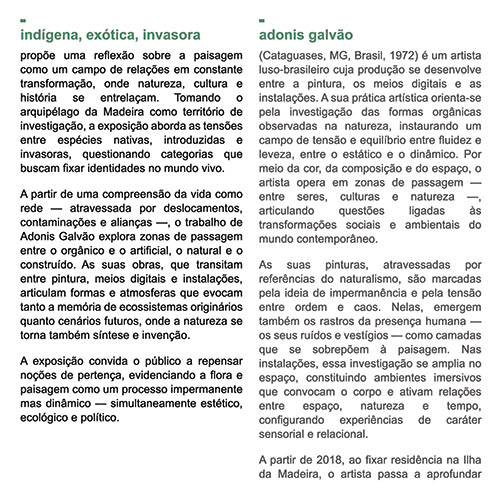
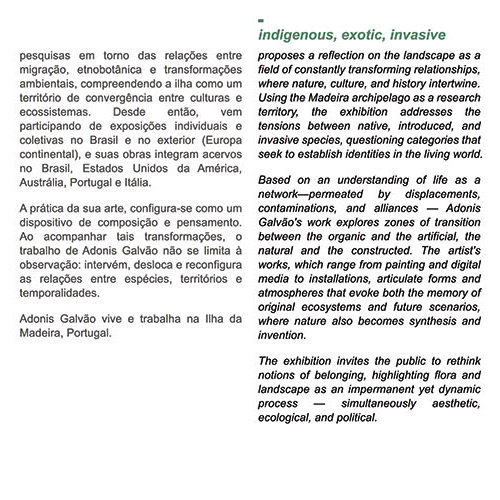
Indigenous, Exotic, Invasive proposes a reflection on the landscape as a field of constantly transforming relationships, where nature, culture, and history intertwine. Using the Madeira archipelago as a research territory, the exhibition addresses the tensions between native, introduced, and invasive species, questioning categories that seek to establish identities in the living world.
Based on an understanding of life as a network—permeated by displacements, contaminations, and alliances—Adonis Galvão's work explores zones of transition between the organic and the artificial, the natural and the constructed. The artist's works, which range from painting and digital media to installations, articulate forms and atmospheres that evoke both the memory of original ecosystems and future scenarios, where nature also becomes synthesis and invention.
The exhibition invites the public to rethink notions of belonging, highlighting flora and landscape as an impermanent yet dynamic process—simultaneously aesthetic, ecological, and political.
ADONIS GALVÃO
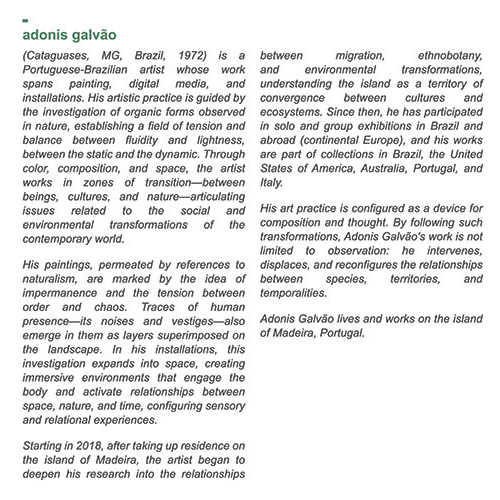
Adonis Galvão (Cataguases, MG, Brazil, 1972) is a Portuguese-Brazilian artist whose work spans painting, digital media, and installations. His artistic practice is guided by the investigation of organic forms observed in nature, establishing a field of tension and balance between fluidity and lightness, between the static and the dynamic. Through color, composition, and space, the artist works in zones of transition—between beings, cultures, and nature—articulating issues related to the social and environmental transformations of the contemporary world.
His paintings, permeated by references to naturalism, are marked by the idea of impermanence and the tension between order and chaos. Traces of human presence—its noises and vestiges—also emerge in them as layers superimposed on the landscape. In his installations, this investigation expands into space, creating immersive environments that engage the body and activate relationships between space, nature, and time, configuring sensory and relational experiences.
Starting in 2018, after taking up residence on the island of Madeira, the artist began to deepen his research into the relationships between migration, ethnobotany, and environmental transformations, understanding the island as a territory of convergence between cultures and ecosystems. Since then, he has participated in solo and group exhibitions in Brazil and abroad (continental Europe), and his works are part of collections in Brazil, the United States of America, Australia, Portugal, and Italy.
His art practice is configured as a device for composition and thought. By following such transformations, Adonis Galvão's work is not limited to observation: he intervenes, displaces, and reconfigures the relationships between species, territories, and temporalities.
Adonis Galvão lives and works on the island of Madeira, Portugal.
INDIGENOUS, EXOTIC, INVASIVE
To inhabit the world is to occupy a shared territory, traversed by disputes, cooperation, and metamorphoses. There is no such thing as a purely “natural” environment: all space is produced by multiple species in continuous relationships of transformation. The air we breathe, for example, is not given—it is the result of the action of plants and microorganisms. The Earth is thus continuously shaped by biodiversity — and, decisively, by plants.
We usually define living beings as those that are born, grow, reproduce, and die. However, this definition is insufficient. A tree or a flower depends on water, soil, light, and a complex network of relationships that also involves the non-living. Life is always an intertwining.
We adorn the institutions of the human imagination with flowers, as well as our homes and rituals. However, their relevance precedes — and surpasses — this symbolic gesture. Our existence is intrinsically linked to flowers, plants, and the nature of which we are a part: we are constituted by it, while at the same time we decisively transform it. The flower — indigenous, exotic, invasive — the theme of this exhibition, exemplifies a form of co-authorship: by delegating to insects the continuity of its species, it highlights a world woven by interdependencies, in which each form of life sustains itself in relation to others. Human beings, like almost all organisms, also depend on air to live — and plants are responsible for its renewal, acting as mediators of atmospheric metabolism and architects of the planet's climatic balance.
Emanuele Coccia wrote that the world is, above all, a vegetal entity — more garden than zoo. Plants not only inhabit this garden; they are the ones who conceive and cultivate it. We, like all animals, are products of this profound gardening, simultaneously cultural and agricultural. Plants do not compose the landscape: they are the first to imagine it, shape it, and transform it.I
n this context, categories such as "indigenous", "exotic" and "invasive" reveal as much as they limit our understanding. They project ideas of borders, control, and belonging onto the living world. However, life operates through displacement, contamination, and alliances. There are no fixed territories: all beings are, to some extent, migrants and co-creators of the space they inhabit.
The works gathered here by visual artist Adonis Galvão, in his exhibition “Indigenous, Exotic, Invasive”, take the Madeira archipelago as a sensitive field of investigation: from the original forests, which root the memory of a previous world, to the introduced species that have become landscape, to the exuberance of the flowers, to the invasive plants that are expanding across the territory.Marcia Zoé Ramos(Holds degrees in Visual Arts, Art History, Anthropology, and Photography. Art teacher, mentor, manager, and cultural producer. Lives and works in Rio de Janeiro, Brazil.)
ROOMS
ROOM 1
Before any arrival, there was the forest, the living memory of the land. The Madeira archipelago existed for millennia as a complete world in itself —
islands born from underwater fire, covered by forests that continental Europe had long since lost. The Laurissilva, a forest of laurels, dragon trees, and yew trees, is a relic of the Tertiary period: it survived the ice ages when the rest
disappeared, preserving forms of life that no longer exist anywhere else on the planet. Zambujal, a coastal forest of wild olive trees, inhabited the
slopes most exposed to wind and salt — more fragile, more fragmented, more vulnerable to what was to come.
These forests are not just ecosystems. They are archives. Each tree carries within it a form of time that escapes human measurement.
The artist proposes a look at the archipelago in its entirety — not just the main island, but the complete body: Porto Santo, the Selvagens Islands, the Desertas Islands. Profiles of land in the ocean, each with its own solitude and life. An archipelago is, by nature, a multiplicity without a fixed center — islands that exist in relation, separated by the water that also unites them.
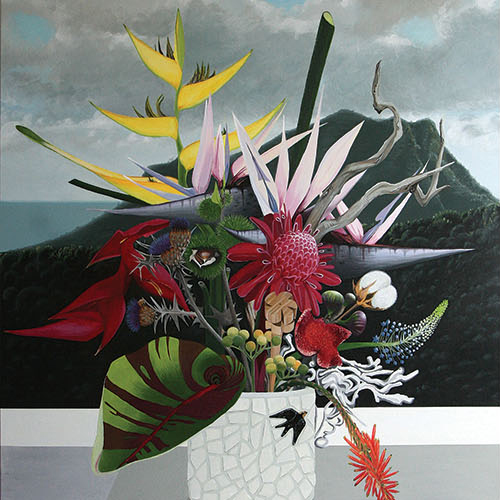
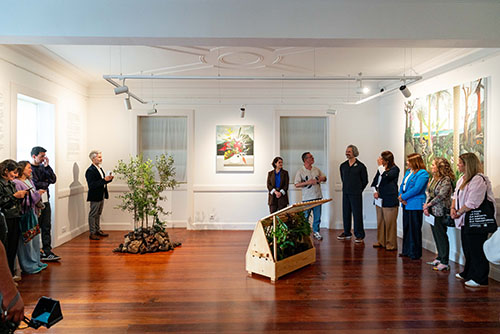
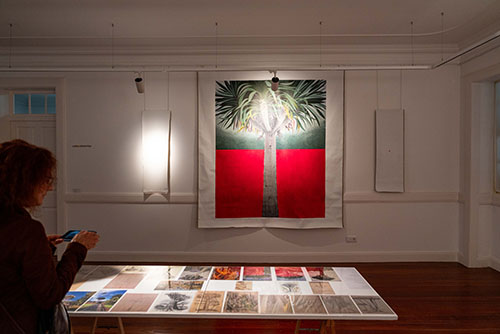
His Flower Vase “INDIGENOUS, EXOTIC, INVASIVE” welcomes the visitor and invites them to think about the complex analogies between nature and the human condition. It warns us that nothing is forever.
Birds have always been present in Galvão's paintings, as essential characters.
Here he presents some invisible sowers of the forest that carry pollen and seeds, make flowers and fruits sprout, open clearings, connect points of the territory that no human path reaches. Without the birds, the Laurissilva forest would not survive.
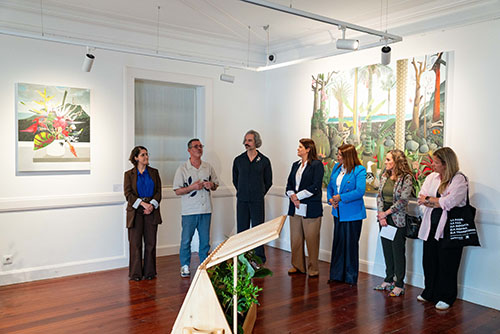
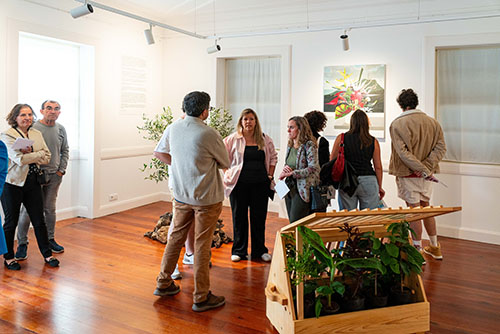
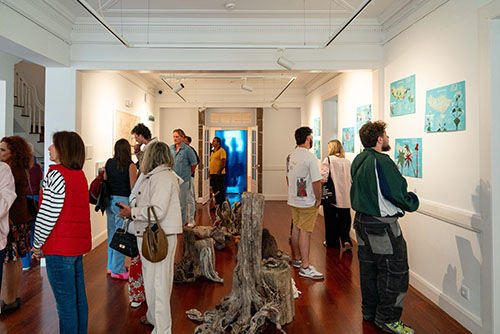
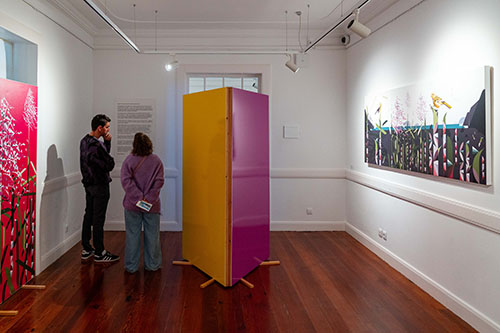
In the center of the room, the artist presents his replica of Ward's Box — that 19th-century invention that allowed live plants to be transported across the oceans without dying. It was she who accelerated the global circulation of species: Galvão imagined his box transporting to Madeira the vine, the sugar cane, the banana tree, the custard apple tree, the mango tree, the passion fruit vine. Plants that today seem as Madeiran as the basaltic, volcanic rock itself. The box is an apparently innocent object — but it is also the symbol of an irreversible transformation: the moment when the island ceased to be only what it was to also become what it received.
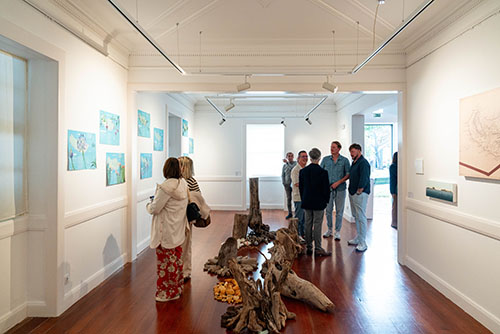
The work “REVOREDO” is a tribute to the house that receives the artist, but it also represents the two forests in body, breathing in the room. They are real, living, present trees that mix and incorporate the flora and fauna of Madeira.
ROOM 2 - DRAGON TREE
"It would only be appropriate, then, to follow the order of human inventions, and speak of these trees first."
Pliny the Elder
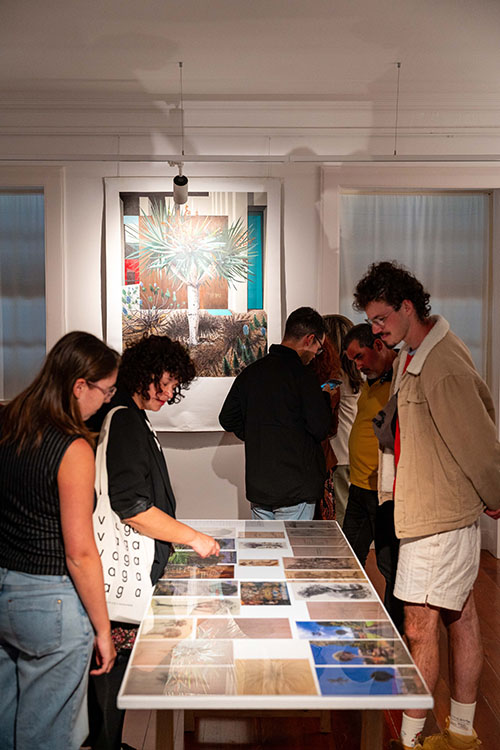
There are trees that existed before human memory. The dragon tree is one of them. An evergreen tree of the Laurissilva forest, with extremely slow growth, it can live for centuries without the human eye perceiving any visible change.
Its silhouette is unmistakable: the robust trunk that opens into a dense, spherical crown. It doesn't grow in a straight line like the trees we know—it branches only when it flowers, dividing and becoming more complex with each life cycle. Its age, impossible to measure by its rings as in other trees, is kept secret by its own architecture.
Pliny the Elder, in his "Natural History," written between 77 and 79 AD, described the Fortunate Isles—today associated with Macaronesia—as an earthly paradise with a mild climate and lush vegetation. Among its riches, he highlighted the precious resins that flowed from the trees of these islands. Dragon's blood was for centuries one of the most sought-after materials in Europe: it was used as varnish, as pigment, as medicine. It healed wounds, sealed wood, dyed fabrics, appeared in alchemy treatises and poems. The tree was simultaneously pharmacy, painting, and myth. This dispute almost extinguished it.
Today, few specimens survive on the islands. The tree that healed was consumed by the same human ambition that drives all extractions. The dragon tree has become, for most of Madeira's inhabitants, an almost invisible presence—known by name, unknown in body.
The artist, an observer of nature, begins in his own territory/backyard in Funchal, when he spots two of these majestic trees and creates a series dedicated to them.
The six paintings in this room traverse the points on the island where it still exists—portraits of a discreet, almost stubborn survival. There is no drama of extinction: Galvão values beauty above all else. His style seeks to encompass the details, the subtleties of this serene presence, of something that has learned to endure by resisting oblivion.
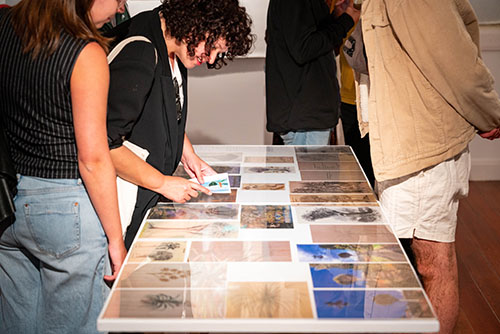
A table holds the vestiges of the artist's research: old maps, quotations in poems, etymologies, photographs, botanical drawings, texts, and treatises. An affective and historical archive that restores to the dragon tree the depth that time has erased.
If the root, in the philosophy of Gilles Deleuze and Félix Guattari, is that which founds and persists—the dragon tree is a root that almost lost its footing. It doesn't invade, it doesn't proliferate, it doesn't spread. It stays. It resists by the simple act of continuing to exist where it has always existed.
ROOM 3 — INVADERS
"Article 7 - The Nation of Plants has no borders. Every living being is free to move through it, move into it, and live in it without any hindrance."
Stefano Mancuso, in The Nation of Plants
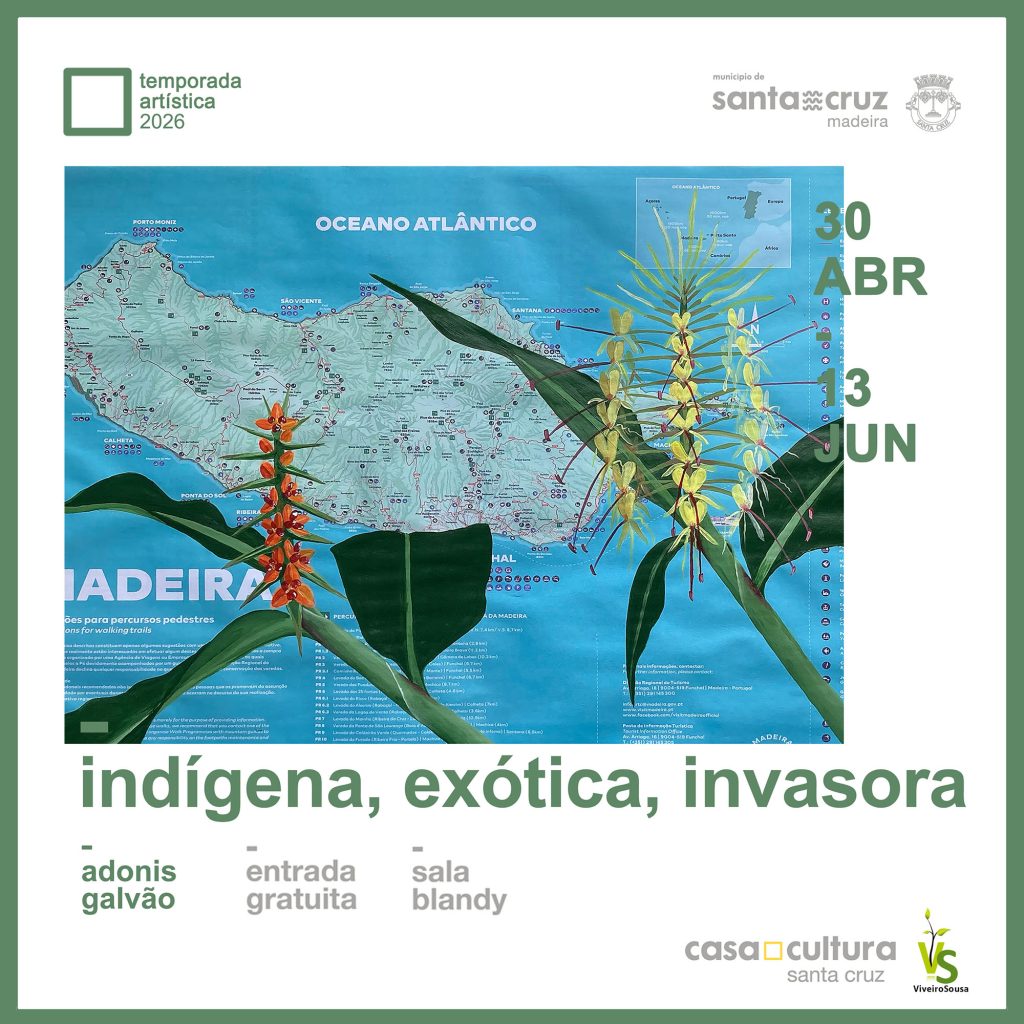
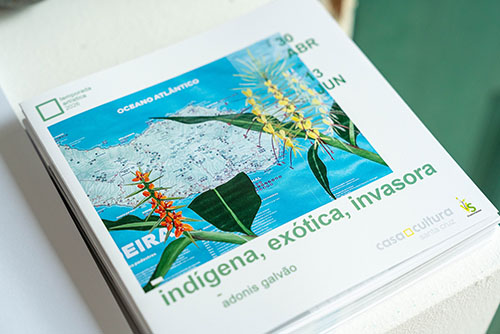
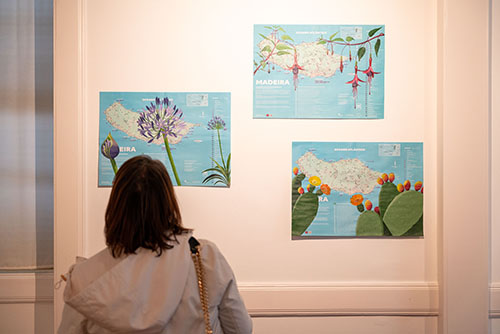
A map is always a decision about what deserves to be seen, and tourist maps distributed free of charge upon arrival on the island are objects of welcome.
They show beaches, viewpoints, restaurants, roads. They show Madeira as a destination, as an ordered landscape, as a place that allows itself to be explored.
What they don't show is what grows on the edges of these paths, on the slopes between the landmarks, in the lands that no tourist visits. What they don't show are the invasive species and their flowering.
Emanuele Coccia argues that "the life of plants is a cosmogony in action, the constant genesis of our cosmos. The practical implications of this vision are profound and invite us to rethink our relationship with the environment." In this sense, the artist's intention is not to establish a position on these plants or to investigate what the influence of the various agents on the form or extent of propagation may be, what are the causes that can expand it and those that should limit it.
He knows that rarely does the plant population of a territory belong to him entirely. Plants are either native to the soil they inhabit, or they are colonized species, transported by various means. For him, what matters is that each plant has its paradise, its central point, from which it originates and radiates.
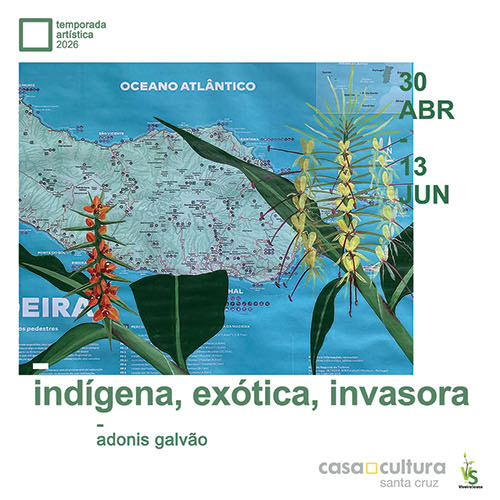
In the “tourist” maps, Galvão intervenes on this silent invasion. Each map received the painting, with the artist's delicate and realistic strokes, of an invasive plant in bloom — beautiful, vigorous, in full expansion. The flower on the map is an overlay of realities: below, the territory as power represents it; above, the territory as it actually grows.
The invaders do not appear in tourist itineraries, but they are everywhere — trying, in every way, to gain space. They are the rhizome that official maps refuse to map.
The Maps of the Invaders transform the official copy of the territory into a living map, where what was erased returns in bloom.
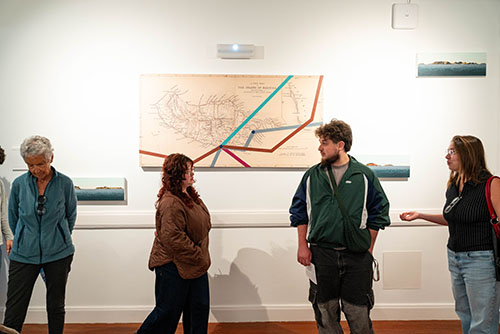
The work “CABOSATLÂNTICOS” deepens this idea of invisible invasion, but descends to the underground, to the submarine. On an old map of the island, the artist traces the routes of the intercontinental fiber optic cables that now cross the ocean floor.
Madeira is, geographically, a node: a meeting point between Europe, Africa, and the Americas. Beneath the water that surrounds it, data flows connect entire continents. No one sees them. No one feels them. But everything we communicate, research, and transmit travels through there.
The artist reads these cables as a silent, submerged, underground technological invasion. Not of roots or plant rhizomes, but of digital networks that replicate, in their own way, the same logic of horizontal and invisible expansion. The rhizome has become fiberglass.
In the center of the room, the work “RODAVIVA” reigns: the sea brought what no one ordered. Galvão collected, in Arco de São Jorge — on one of the wildest slopes of the island, where he also shares a centuries-old residence with his philosopher partner — the objects deposited by the tides: woods of unknown origin, plastics deformed by salt and time, remnants of rope,
fragments of unrecognizable morphology.
In his wanderings, he found shards of porcelain, empty bottles, glass, exotic seeds.
All these traces are arranged in an installation that has no other author than the ocean itself. The artist assists as a collector and aesthetic organizer.
Each tide is a new edition — it removes, adds, bends, transforms. The objects arrived from places we don't know how to name, traveled distances that we cannot measure and were deposited here like a writing that we don't read, but that exists.
This is the newest invasion: neither vegetal nor digital, but detrital. The invasion of what the world discards and the sea redistributes. A constant metamorphosis, without intention and without destination — pure movement, pure arrival.
The works are cartographies of what is not shown: the plant that blooms outside the map, the cable that connects continents at the bottom of the sea, the object that the ocean brings.
The island, we realize, was never just what the maps said it was.
ROOM 4 — THE GARDEN
Utopia. From the Greek ou-topos: the place that does not exist.
Thomas More coined the word in 1516 to describe an imaginary island of just and perfect society — a critique disguised as a dream. Utopia has,
since then, come to mean the desire for a world better than this one, situated in a place that no map can identify: an island separated from the real world by water that protects it from imperfection.
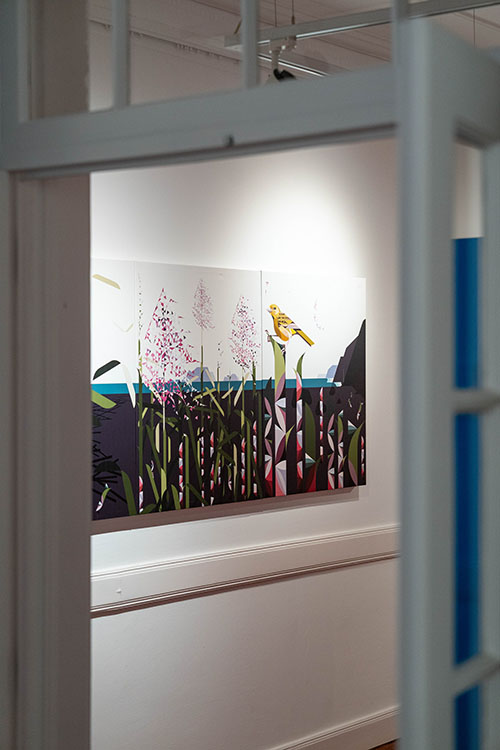
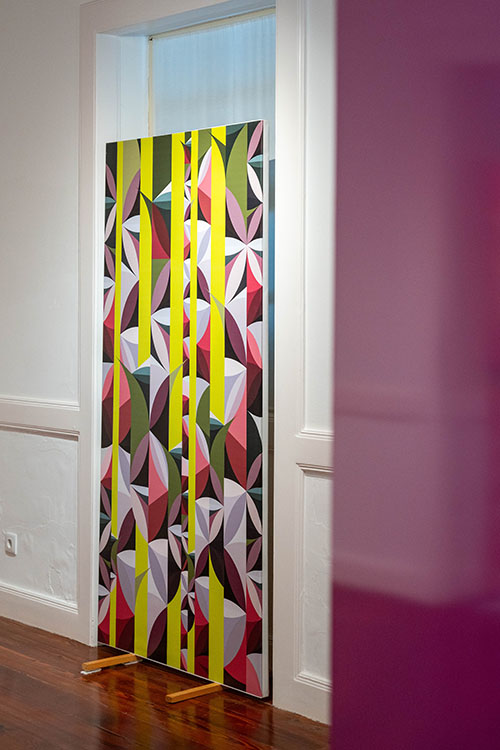
The panels of the work “FLORDACANA-DE-AÇUCARIMPACTAAPRODUÇÃO” were created by Galvão,
entirely in computer graphics and printed in vibrant colors — the
horizon of Madeira adorned with flowering canes, birds in flight, a lush and luminous landscape. Beautiful as a memory that never existed, or as a future that we choose to believe is possible.
The artist presented the installation in a real garden, in Ponta do Sol — images of nature placed in the middle of nature, creating a mirror that reflects and, at the same time, replaces.
Adonis Galvão observes that “the flowering of sugarcane is not seen, as it is prevented because it compromises productivity; just as ideas, people, projects and cycles are inhibited from flourishing, as they impact a given system. The proposal for a sugarcane flowering installation aims to highlight the importance of what is not seen. The triangular shapes of the sugarcane flowers represent unity, the four elements — earth, water, fire and air — without which nature does not exist. The flower represents vitality, the restart of the cycle, a metaphor for vital energy.”
Here, inside the room, in this digital horizon, the flowers never wither. The most recent invasion has no roots, no rhizomes, no seeds. It does not grow.
It does not die. It simply remains.
Coccia states that the natural environment, as modernity imagined it, does not exist — the world is always, in all its parts, conceived and
constructed. Each species is, simultaneously, artist and curator of the others. The history of the Earth is a history of art.
In this sense, the synthesis garden is also a work of our species—an expression of what we have become, a curation of what we choose to see. If each living being inhabits structures that it did not create alone, this garden is an inverted utopia: not the place that does not exist as a promise, but the place that does not exist as a warning.
Marcia Zoé Ramos
(Holds degrees in Visual Arts, Art History, Anthropology, and Photography. Art teacher, mentor, manager, and cultural producer. Lives and works in Rio de Janeiro, Brazil.)
EXHIBITION CATALOG
View an enlarged version on a new page here.
Powered By EmbedPress
EXHIBITION FLYER
Powered By EmbedPress
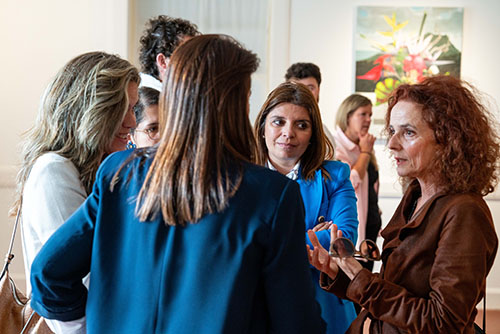
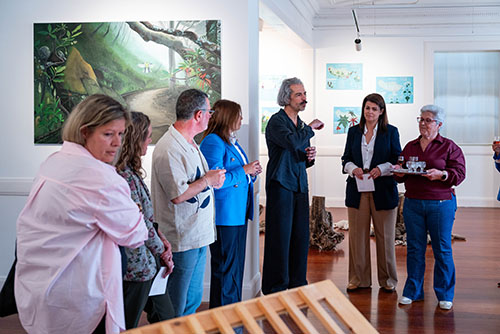
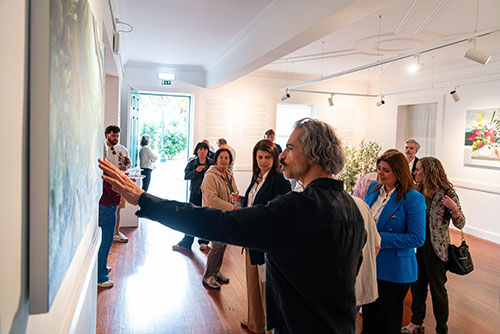
OPENING PHOTOS
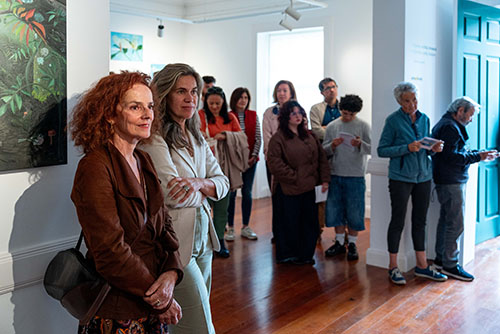
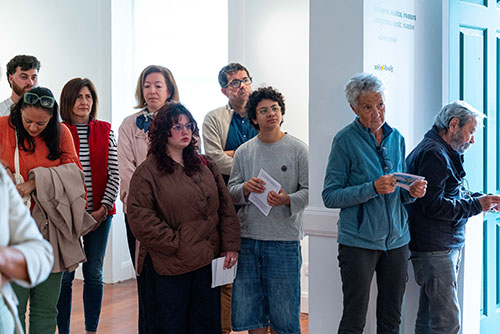
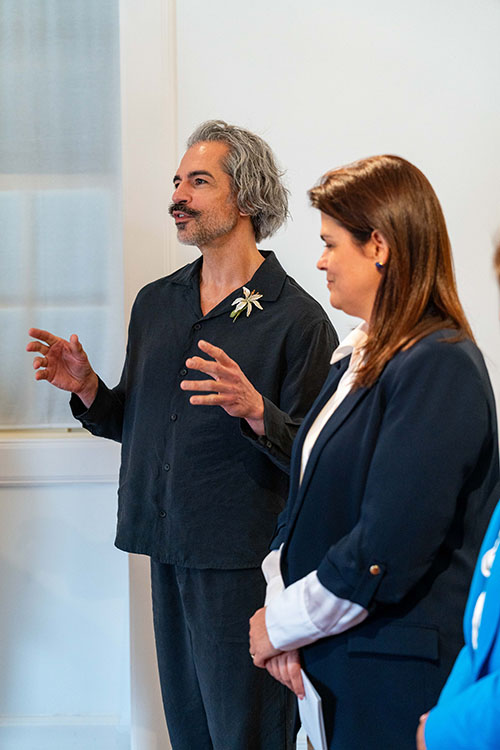
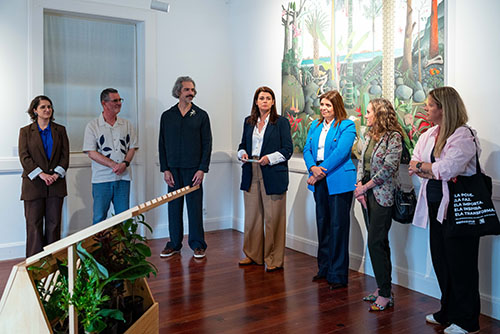
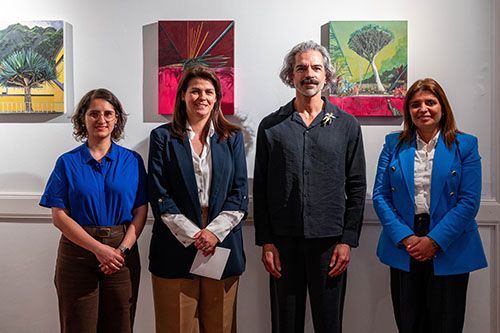
EXHIBITION PHOTOS
VÍDEO